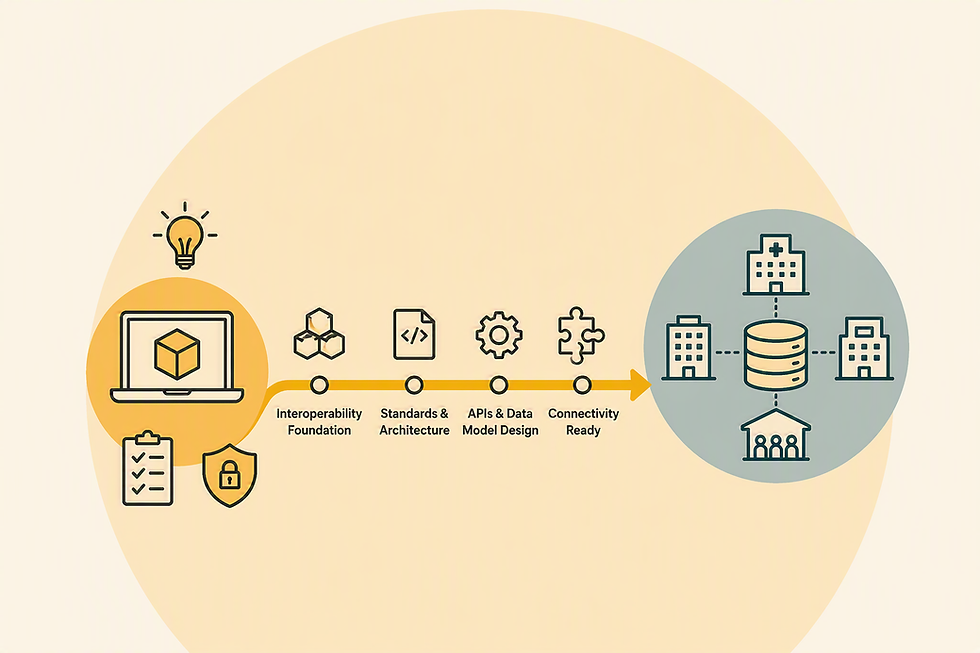
Why APIs Don't Automatically Deliver Interoperability

To many suppliers, healthcare interoperability begins and ends with APIs.
If an API exists, the thinking goes, information can be exchanged and the interoperability challenge has effectively been solved.
In reality this may have done little beyond scratching an immediate itch.
APIs are important. They provide technical mechanisms for exchanging information and can play a vital role in delivering interoperability services. Tyhey are, however, only one component of a much wider picture. Successful interoperability is not measured by whether information can technically move between systems, it is measured by whether organisations are able to use information effectively and achieve meaningful outcomes.
APIs Solve Technical Problems
When organisations begin discussing interoperability, it is understandable that APIs quickly become part of the conversation, after all, they are visible, tangible and often well documented.
This naturally creates a sense that interoperability is largely a technical exercise, which can be true, although more often the existence of an API is simply the starting point rather than the destination. Identifying an API to establish a connection may solve the immediate requirement but does not consider future-proofing or scalability.
The Question Isn't "Can We Connect?".
A more useful question is often "What are we trying to achieve?".
Thinking Beyond Today's Requirement
A supplier may only need one dataset today, next year they may require additional systems or organisations, shared views of information, population-level analysis or specific workflows or reporting requirements. The original API connection may still work perfectly, however decisions made solely around today's requirement can sometimes create limitations tomorrow.
Interoperability decisions frequently influence:
Architecture
Data strategy
Information sharing
Future integration
Secondary uses of data
The organisations that achieve the greatest value are often those that consider these possibilities early.
More Than Technical Connectivity
Two systems exchanging information successfully does not automatically mean interoperability has been achieved.
Questions still remain:
Is the information meaningful?
Does it support workflows?
Is it accessible to the people who need it?
Can it support future requirements?
Does it align with wider organisational objectives?
These considerations often have a greater impact on long-term success than the technical connection itself.
A Practical Approach
The best interoperability solutions balance current needs with future opportunities.
Sometimes a simple API integration is exactly the right answer, in other situations, a broader architectural approach may create significantly more value over time.
The important thing is understanding the implications of those decisions before they are made.
How Osprey Can Help
Osprey helps organisations evaluate interoperability requirements in the context of wider objectives, future opportunities and practical delivery considerations.
We help suppliers and healthcare organisations identify solutions that meet immediate needs while supporting sustainable long-term outcomes.
Related Solution
Future-ready interoperability architecture designed around practical outcomes rather than short-term technical requirements.