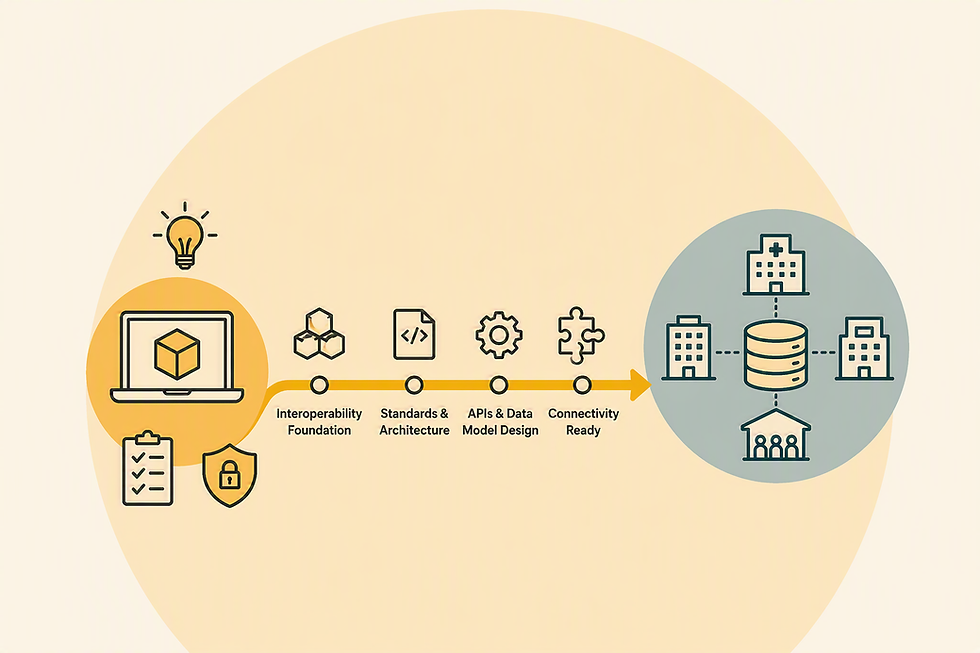
Why Connectivity Is Only Part of the Interoperability Story

One of the most common misunderstandings in healthcare interoperability is the assumption that connectivity and interoperability are the same thing.
They are closely related.
They are both important.
But they are not the same.
Many suppliers begin their interoperability journey by focusing on connectivity. Understandably so. Establishing secure connections is often one of the first technical challenges that needs to be addressed.
If systems can communicate with one another, many organisations assume interoperability will naturally follow.
Unfortunately, it is rarely that simple.
Connectivity Enables Interoperability
Connectivity is best viewed as an enabler.
It creates the pathway that allows information to move between systems, organisations and services.
Without secure and reliable connectivity, interoperability simply cannot exist.
However, a connected system is not necessarily an interoperable system.
Information may technically move from one place to another while still providing very little value to the people who need it.
Connectivity answers the question
Can these systems communicate?
Interoperability answers a much more important question:
Can these organisations work together effectively using shared information?
Information Has to Be Useful
Healthcare organisations rarely connect systems for the sake of connectivity itself.
The objective is usually to improve care, support decision making, reduce duplication or create more efficient services.
A technically successful connection that delivers unusable, incomplete or poorly structured information may technically work while still failing to support these objectives.
This is one reason why successful interoperability requires more than network connections and interfaces.
It requires an understanding of how information is used, who needs access to it and what outcomes the solution is intended to support.
Interoperability Is Organisational As Well As Technical
The most successful interoperability programmes typically involve more than technology.
Governance
Processes
Responsibilities
Operational models
Information sharing agreements
All of these elements can influence whether interoperability succeeds in practice.
Suppliers entering healthcare environments sometimes expect the technical challenge to dominate.
In reality, organisational considerations often have just as much impact on the eventual outcome.
Focus On Outcomes
The suppliers that achieve the greatest success are often those that focus on outcomes rather than technical capabilities.
Instead of asking:
How do we connect?
they ask:
What problem are we solving?
This subtle shift in perspective often leads to better design decisions, smoother implementations and more valuable interoperability outcomes.
How Osprey Can Help
Osprey helps suppliers and healthcare organisations move beyond connectivity alone and develop practical interoperability capabilities that support real-world outcomes.
By combining architecture, integration, onboarding and connectivity expertise, we help organisations focus on the information-sharing outcomes they are trying to achieve rather than the technology alone.
Related Solution
Secure, streamlined networking enabling trusted connectivity without traditional networking overheads.