Integration Options for Smaller Organisations
Updated: Jul 12
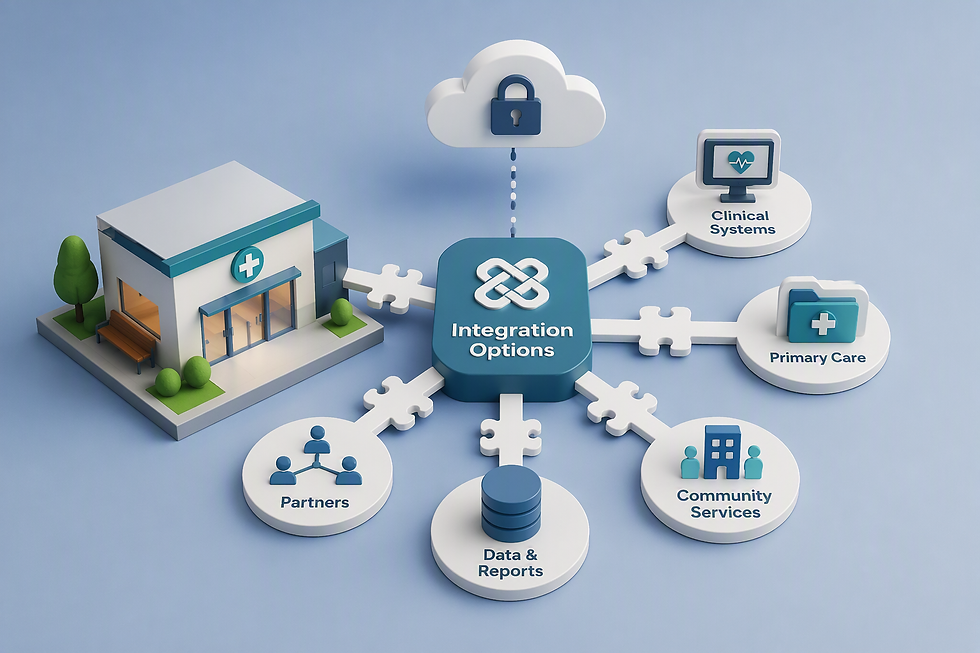
When people talk about interoperability in the NHS, the conversation often focuses on large-scale programmes. Major EPR deployments, Shared Care Records, Integrated Care System initiatives and national transformation programmes tend to dominate the discussion.
But a significant amount of care is delivered by smaller organisations.
Community providers, hospices, voluntary sector organisations, specialist services and independent providers all play important roles within patient pathways. They are expected to collaborate with partners, participate in integrated care models and contribute to joined-up services. Yet many of these organisations face challenges that make interoperability far more difficult to achieve.
Unlike larger NHS organisations, smaller providers often have limited technical resources, smaller budgets and fewer specialist staff available to support integration projects. Their systems may not have been designed with interoperability in mind, and they may struggle to justify investment in dedicated integration infrastructure.
As a result, valuable information can remain trapped within organisational boundaries.
This creates a range of practical challenges:
Referrals that rely on emails, telephone calls or manual processes
Delays in sharing information between services
Limited visibility of activity occurring elsewhere in the care pathway
Increased duplication of effort for clinical and administrative teams
A fragmented experience for patients moving between organisations
The impact can be significant. Even where larger organisations are well connected, gaps created by smaller providers being unable to participate can weaken the effectiveness of the entire pathway.
True interoperability cannot be limited to the organisations with the largest budgets.
The challenge is finding an approach that is proportionate.
Smaller providers do not need a large integration team or a complex integration platform. What they need is a practical way to exchange information with the organisations they work with most closely.
This is where alternative delivery models become increasingly important.
A hosted Integration as a Service approach can remove many of the traditional barriers to entry. Rather than investing in infrastructure, specialist skills and ongoing platform management, organisations can consume interoperability as a managed service. This provides access to modern integration capabilities without the complexity, risk and cost traditionally associated with implementation and support.
The benefits are clear:
Lower upfront investment
Reduced demand on internal technical resources
Faster onboarding to interoperability initiatives
Access to specialist expertise when needed
Scalability as requirements grow over time
It also allows organisations to focus on the outcomes that matter rather than the technology itself.
The goal is not to own an integration platform. The goal is to enable better communication, stronger coordination and more effective patient care.
As neighbourhood working and integrated care continue to develop, ensuring that smaller organisations can participate fully will become increasingly important. A healthcare system is only as connected as its least connected participant.
By lowering the technical and financial threshold for participation, interoperability becomes accessible to a much broader range of organisations, helping to create more inclusive and effective care pathways across the health and care system.
At Osprey, we provide hosted interoperability services designed specifically for organisations that need the benefits of integration without the burden of managing a complex technical platform. Whether supporting a single service, connecting into a neighbourhood care model or enabling participation in wider ICS initiatives, we take responsibility for the underlying integration capability so that teams can focus on delivering care.
Our aim is to make interoperability practical, affordable and achievable for organisations of every size, ensuring that no provider is excluded from integrated care simply because of cost or complexity.
Related Solution: Evolved Integration Services
Effective interoperability isn't only for large programmes. Discover scalable integration approaches designed to meet organisations where they are today.