Helping Neighbourhoods Plan Interoperability in a Practical Way
Updated: Jul 11
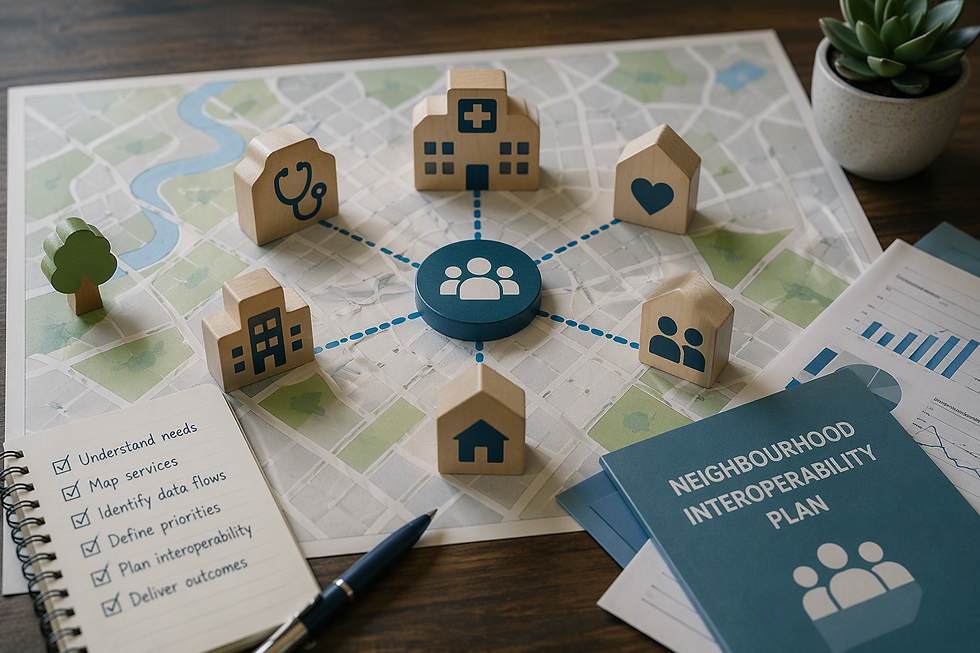
Neighbourhoods are an increasingly important part of the NHS landscape, with their growing focus on delivering care closer to home, improving coordination between services and supporting people through more connected, community-based models of care. The ambition is clear: bring together the organisations and professionals involved in a person's care and enable them to work more effectively as a team.
But for Neighbourhoods to succeed, information needs to move as effectively as care does.
This is where Neighbourhoods are likely to encounter challenges as they do not operate within the boundaries of a single provider, involving a combination of GP practices, community services, mental health teams, social care, acute services, voluntary sector organisations and specialist providers.
Each of these organisations has its own systems, priorities, processes and governance arrangements.
The result is a complex interoperability landscape.
Information may exist across multiple systems. Referrals may pass through several organisations. Clinicians may need to access information from sources they do not routinely use. Services may have different levels of digital maturity and different capabilities to participate in data sharing initiatives.
Neighbourhood interoperability could simply be approached in the same way as larger organisational programmes, with attention placed on technology platforms, architecture diagrams and long-term strategies before a clear understanding is developed of what neighbourhood teams actually need.
A more practical approach starts with the pathway rather than the platform.
Instead of asking:
"Which systems should we connect?"
Neighbourhoods should begin by asking:
"How does care move through the neighbourhood, and where does information need to move alongside it?"
This shifts the focus onto real operational challenges.
For example:
How are referrals managed between organisations?
Where do clinicians lack visibility of patient activity?
Which processes rely heavily on manual communication?
Where are delays occurring because information is unavailable?
Which teams need access to shared information to coordinate care effectively?
Once these questions are understood, priorities become much clearer.
Rather than attempting to solve every interoperability challenge at once, neighbourhoods can focus on a small number of high-value use cases that have a direct impact on patient care.
These might include:
Referrals between neighbourhood services
Discharge coordination
Community and acute care collaboration
Shared care planning
Multi-disciplinary team working
Visibility of patient activity across organisations
Targeting these areas often delivers value more quickly while creating a foundation for future expansion. This approach also helps avoid one of the most common mistakes in interoperability planning: trying to build the perfect solution before delivering any benefit.
Neighbourhoods will evolve, teams will change, services will develop and priorities will shift. A plan that assumes everything can be designed up front will struggle to keep pace with reality.
Practical interoperability planning recognises that progress is usually incremental.
Start with a clear problem.
Deliver a measurable improvement.
Learn from the outcome.
Build on the success.
Over time, this creates a more sustainable and adaptable interoperability capability than attempting large-scale transformation in a single step.
It also helps secure stronger engagement from operational and clinical teams.
As neighbourhood working continues to develop across the NHS, successful interoperability will depend less on the size of the programme and more on the quality of the planning behind it.
The neighbourhoods that gain the greatest value will be those that remain focused on practical outcomes, clear priorities and realistic delivery.
Because ultimately, neighbourhood interoperability is not about connecting every system.
It is about connecting the people, services and information that matter most to patient care.
At Osprey, we help neighbourhood teams plan interoperability in a way that is practical, achievable and focused on outcomes. Rather than starting with technology, we begin by understanding the pathways, challenges and priorities that exist within each neighbourhood. We work with organisations to identify the areas where better information sharing will have the greatest impact, helping to create realistic roadmaps that deliver value quickly while supporting long-term integration goals.
Our purpose-built Neighbourhood and ICB interoperability audits will help with the initial thinking and clarify the path to success. Our focus is always on making interoperability work in the real world, supporting neighbourhood teams with solutions that improve coordination, reduce friction and help deliver better care closer to home.
Related Solution: ICB Shared Data & Connectivity Solutions
Strong data sharing starts with practical planning. Learn how Osprey helps organisations create sustainable foundations for collaboration.