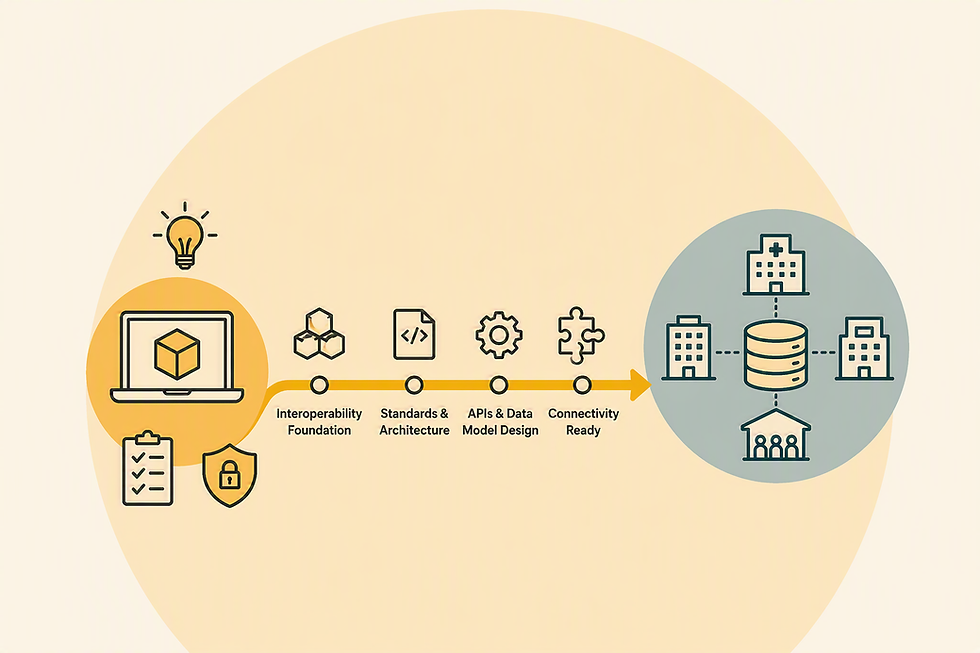
Making NHS Interoperability Work for Suppliers

Throughout this supplier insight series, we've explored a range of topics that organisations frequently encounter when entering the NHS market. Connectivity, onboarding, information sharing, APIs, assurance, adoption and integration are often discussed as separate subjects, sometimes even by separate teams, but in reality they are usually different aspects of the same challenge.
One of the reasons interoperability can appear daunting to suppliers is that it sits at the intersection of several disciplines. Technical architecture, operational processes, information governance, cyber security, clinical workflows and organisational change all influence success. Organisations that approach interoperability as a simple technical exercise often discover that the technical component is only one part of a much larger picture.
This can be surprising, particularly for suppliers whose previous experience comes from sectors where system integration is largely a technical discussion. In healthcare, successful interoperability is ultimately about enabling people and organisations to work together more effectively. Technology provides the mechanism, but the desired outcome is almost always operational rather than technical.
Why Suppliers Sometimes Underestimate the Challenge
Many organisations begin their NHS interoperability journey with a relatively straightforward objective. They need access to a patient record. They want to provide information to a clinical system. They need to receive referrals, assessments, observations or outcome data. The requirement appears clear and the technical route initially looks simple.
The assumption is often that, once an API or interface has been identified, the majority of the challenge has been solved.
In practice, that is usually the point at which the real work begins.
Questions quickly emerge around information governance, onboarding, clinical safety, assurance processes, operational ownership, support models and deployment approaches. Organisations discover that technical connectivity forms part of a wider delivery ecosystem, with each component needing to align if meaningful outcomes are to be achieved.
This is one reason suppliers can become frustrated when interoperability appears to move slower than expected. Progress is often being made, but much of that progress is occurring outside the technology itself.
The challenge is rarely the interface, the challenge is creating the environment in which the interface can be used safely, appropriately and effectively.
The Evolution of Interoperability
The interoperability landscape has changed significantly over the last decade. Historically, suppliers often had limited routes into major NHS systems. Interface development could be lengthy, onboarding processes were often unclear and access to technical information was not always straightforward. In some cases, organisations found themselves undertaking substantial work before they could even begin meaningful testing.
Today's environment is considerably more mature.
The adoption of modern APIs, increasing use of FHIR standards, national platform investments and growing recognition of interoperability as a strategic capability have improved accessibility across much of the market. Suppliers now have access to technologies and approaches that make information sharing easier than it has ever been.
At the same time, however, expectations have increased. Healthcare organisations are no longer simply looking for systems that can exchange data. They are increasingly seeking solutions that fit seamlessly into operational workflows, support wider transformation objectives and demonstrate clear value delivery.
The conversation has moved beyond connectivity, the focus is increasingly on outcomes.
APIs Have Changed the Conversation, But Not the Objective
No discussion about modern interoperability would be complete without acknowledging the impact of APIs.
APIs have transformed how suppliers approach healthcare integration. Well-designed APIs can simplify development, accelerate implementation and enable greater flexibility than many traditional integration approaches. However, one of the recurring themes within interoperability programmes is the tendency to confuse API availability with interoperability itself.
An API provides a technical capability, interoperability requires that capability to be applied in a way that delivers meaningful value.
An organisation can expose hundreds of API endpoints and still struggle to achieve effective information sharing if the underlying problems have not been understood.
Conversely, relatively straightforward interfaces can generate significant benefits when they have been designed around genuine operational needs.
Successful suppliers recognise this distinction early. The objective is not to consume an API, the objective is to improve a process, support a service or enable a better outcome, the API is simply one of the mechanisms used to achieve that goal.
Why Simplicity Matters
If there is one lesson that consistently emerges across interoperability programmes, it is that complexity rarely creates value on its own.
Healthcare environments are already complex. Multiple organisations, competing priorities, legacy systems, financial pressures and evolving service models create enough challenges without introducing unnecessary technical or operational complication.
The suppliers that often gain the greatest traction are not necessarily those offering the largest feature sets or the most sophisticated technical architectures.
Instead, success frequently comes from making things easier.
Easier to understand.
Easier to deploy.
Easier to govern.
Easier to support.
Easier to adopt.
This principle applies equally to technical design, onboarding approaches and customer engagement. Organisations generally respond positively when interoperability feels achievable rather than overwhelming.
Practicality often wins where complexity struggles.
Adoption Begins Before Go-Live
One of the most overlooked aspects of interoperability is adoption.
Suppliers naturally spend considerable effort designing systems, building interfaces and delivering technical functionality. Yet technical deployment alone does not guarantee success. Healthcare organisations invest in digital solutions because they want to improve services, remove inefficiencies, enhance decision-making and ultimately support better outcomes for patients.
Those benefits only emerge when solutions become embedded within daily practice.
This means adoption considerations should begin long before implementation is complete.
How will teams use the information?
How will workflows change?
What operational improvements are expected?
Who will own the process?
How will users be supported?
The stronger the answers to these questions, the greater the likelihood that interoperability will deliver lasting value rather than simply creating another source of data.
Interoperability Is Becoming a Business Capability
Perhaps the most significant change in recent years is the growing recognition that interoperability is no longer purely a technical discipline. Healthcare organisations increasingly view interoperability as an organisational capability that supports wider strategic objectives.
This is an important shift for suppliers.
It means discussions are increasingly centred around transformation, operational improvements, productivity, service integration and patient outcomes, rather than simply technical connectivity.
The suppliers that thrive within this environment are typically those that position interoperability as an enabler of broader objectives rather than the objective itself.
The technology remains important, but it sits within a much larger context.
Making NHS Interoperability Work
The organisations that achieve the greatest success in NHS interoperability rarely do so because they possess the most technology. They succeed because they understand the environment in which that technology will operate.
They recognise that APIs, interfaces, standards and platforms are all important, but they also appreciate that governance, onboarding, information sharing, operational workflows and adoption are equally critical. Most importantly, they remain focused on the outcomes they are trying to achieve.
Interoperability has matured considerably over recent years and the direction of travel is positive. Standards continue to evolve, platforms continue to improve and information sharing is becoming increasingly accessible. Yet the organisations that consistently succeed are still those that combine good technology with practical delivery, clear objectives and a strong understanding of their users.
The tools available to suppliers will continue to change, the importance of solving real problems will not.
How Osprey Can Help
At Osprey, we help suppliers and NHS organisations navigate interoperability in a way that balances technical capability with practical delivery.
Our experience spans architecture, API strategy, onboarding, connectivity, shared care records, information sharing, assurance and operational support. Having worked across both supplier and healthcare environments, we understand that successful interoperability is rarely about technology in isolation. It is about creating solutions that can be delivered, adopted and sustained within real-world healthcare settings.
Whether you're preparing for your first NHS interface, expanding an existing digital platform or looking to simplify a complex interoperability challenge, our focus remains the same:
Helping organisations make interoperability work.
Related Solution
Navigate assurance, accreditation and connectivity requirements without unnecessary delay or complexity.