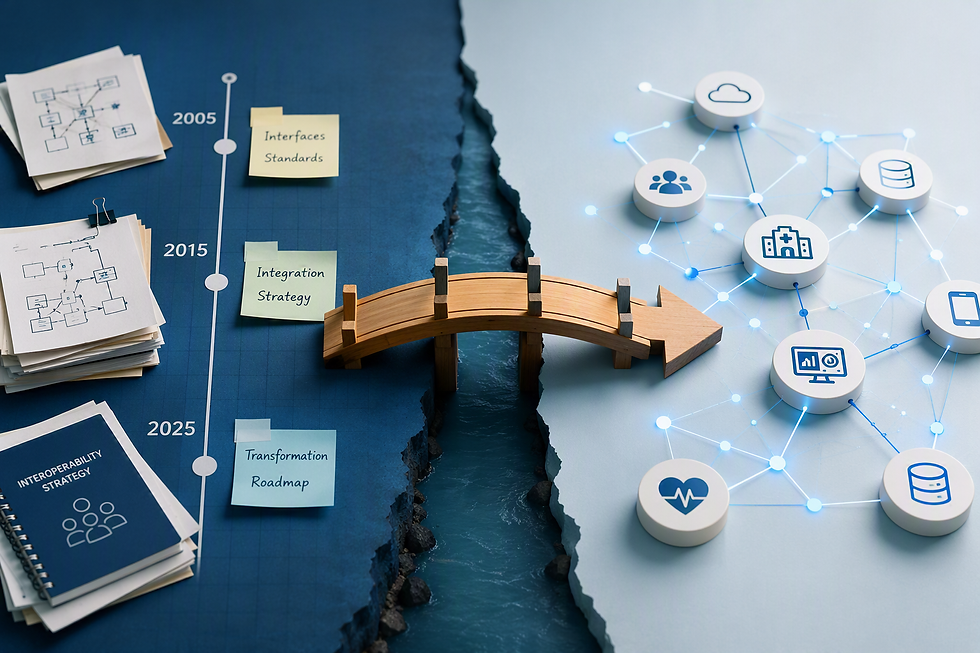
From Interfaces to Intelligence
Updated: Jul 11
The Next Step in NHS Integration

Basic interfacing has been the foundation of NHS interoperability for many years.
Moving data from one system to another, ensuring that information can be exchanged and accessed across organisational boundaries. This has enabled significant progress, connecting systems that were once isolated and improving visibility across care settings.
But the NHS is now moving beyond that stage.
The focus is shifting from simply moving data to how that data is used.
Across integrated care systems, there is growing emphasis on:
Automation of operational processes
Event-driven workflows that respond to changes in real time
Data-driven decision making at the point of care
Laying the foundations for advanced analytics and AI
These are the next steps in digital maturity.
But none of them work without strong integration.
If the underlying data is incomplete, delayed or inconsistent, then the processes and insights built on top of it will reflect those same limitations. Automation will be unreliable. Decision support will be compromised. Analytical outputs will lack credibility.
This is where the focus of healthcare interoperability needs to evolve.
It is no longer enough to ask whether systems are connected. The question is whether the data flowing between them is usable, timely and meaningful in the context of real-world care.
That means moving beyond basic interfaces towards integration that supports:
Accurate, structured data that can be used reliably across systems
Timely data flows that reflect what is happening now, not what has already happened
Event-driven patterns that trigger action, not just display information
Alignment with clinical and operational workflows, not just technical architecture
This is the point where integration begins to enable intelligence.
Not in the sense of complex algorithms alone, but in supporting better, faster and more informed decisions across the system.
Making interoperability work in practice means building this foundation first.
Ensuring that data is not only exchanged, but is accessible through clear, user-facing interfaces, aligned to workflows and trusted by the teams who depend on it.
Because without that, the next wave of capability, automation, optimisation and AI, will struggle to deliver real value.
In the current NHS landscape, there is a growing push toward smarter use of data. But that ambition depends entirely on the quality of the underlying integration.
The next step in NHS interoperability is not just about moving data more efficiently. It is about making that data genuinely useful.
Because intelligence is not created at the point of analysis. It is enabled by the quality, timing and usability of the data that comes before it.
At Osprey, we see integration as the foundation for everything that comes next. Whether organisations are looking to automate workflows, support advanced analytics or prepare for the growing role of AI in healthcare, success depends on having reliable, timely and well-structured data.
We help NHS organisations build the interoperability foundations needed to move beyond simple data exchange, ensuring information flows are robust, scalable and aligned to real operational needs. Because before data can deliver intelligence, it first needs to be connected, trusted and available where it creates the greatest value.
Related Solution: Evolved Integration Services
Modern interoperability is about more than moving messages between systems. Learn how Osprey helps organisations unlock greater value from connected data.